Amieve Empire: Difference between revisions
(Created page with "The Urris Empire was one of the most influential states of the fourth millenium. It imposed the Peace of Urris in 3796, shaping the world politics until its fall in 4000, during the Eruption of the Urrian Traps.<div style="float: right;"> {{Wikibundi:WikiProject_Transwiki/Template:Infobox |bodystyle=background-color:#F8F9FA;border:solid 2px #A2A9B1 |title=Urris Empire |image=200px|3796-4000 State flag |titlestyle=background-color:#D6D6D6; |headers...") |
|||
| (47 intermediate revisions by the same user not shown) | |||
| Line 1: | Line 1: | ||
<div style="float: right;"> | |||
{{Wikibundi:WikiProject_Transwiki/Template:Infobox | {{Wikibundi:WikiProject_Transwiki/Template:Infobox | ||
|bodystyle=background-color:#F8F9FA;border:solid 2px #A2A9B1 | |bodystyle=background-color:#F8F9FA;border:solid 2px #A2A9B1 | ||
|title= | |title=Amieve Empire | ||
|image=[[File: | |image=[[File:amieve_mibrox.png|frameless|200px|Mibrox Dinasty State flag]]<br> | ||
''Mibrox Dinasty State flag'' | |||
|titlestyle=background-color:#D6D6D6; | |titlestyle=background-color:#D6D6D6; | ||
|headerstyle=background-color:#D6D6D6; | |headerstyle=background-color:#D6D6D6; | ||
| Line 11: | Line 12: | ||
<small>XXXXX</small></div> | <small>XXXXX</small></div> | ||
|label2=Capitals | |label2=Capitals | ||
|data2= | |data2= | ||
Amievimmia (2650-3018) Sapnava-Mieir-Klarmoyu(2815-2860) Sugimmia (3018-3058) Amievimmia (3058-3113) | |||
|header3=Languages | |header3=Languages | ||
|label4=Administrative | |label4=Administrative | ||
|data4= | |data4= Bossiemian | ||
|label5=Liturgical | |label5=Liturgical | ||
|data5= | |data5=Archaic Mecim/Miao | ||
|header6=Government | |header6=Government | ||
|label6=<br> | |label6=<br> | ||
|data6= | |data6= XXXXX | ||
|header7=Religion | |header7=Religion | ||
|label7=[[Miaopiaoism]] | |label7=[[Miaopiaoism]] | ||
|data7= | |data7= | ||
<div style="float: right;"> | <div style="float: right;"> | ||
*Aithran Orthodox <small>(official)</small> | |||
*Aithran Orthodox <small>( | *Siem Synchretism<small>(accepted)</small> | ||
* | |||
</div> | </div> | ||
|header8=Currency | |header8=Currency | ||
|data8= | |data8=XXXXX | ||
|header9=Population (in | |header9=Population (in 3) | ||
|data9= | |data9= XXXX | ||
}} | }} | ||
</div> | </div>The Amieve Empire was the first large independent state that rose to rival the magocracies. It was the major power of the Siemetv Plateau It was founded in 2650 by Casm of the Mertoch. It fell in 3113. | ||
=== Timeline === | === Timeline === | ||
---- | ---- | ||
<timeline> | <timeline> | ||
ImageSize = width:900 height: | ImageSize = width:900 height:200 | ||
PlotArea = left:150 right:50 bottom:40 top:10 | PlotArea = left:150 right:50 bottom:40 top:10 | ||
AlignBars = justify | AlignBars = justify | ||
DateFormat = yyyy | DateFormat = yyyy | ||
Period = from: | Period = from:2650 till:3250 | ||
TimeAxis = orientation:horizontal | TimeAxis = orientation:horizontal | ||
ScaleMajor = unit:year increment:100 start: | ScaleMajor = unit:year increment:100 start:2650 | ||
ScaleMinor = unit:year increment:50 start: | ScaleMinor = unit:year increment:50 start:2650 | ||
Define $dx = 5 | Define $dx = 5 | ||
| Line 52: | Line 53: | ||
BarData= | BarData= | ||
bar:Dinasty text:Dinasty | |||
bar: | |||
barset:wars text:Wars & Conflicts | barset:wars text:Wars & Conflicts | ||
| Line 62: | Line 62: | ||
width:30 fontsize:S align:left | width:30 fontsize:S align:left | ||
bar:Dinasty | |||
bar: | from:2650 till:2794 text:"Mertoch" color:green | ||
from: | from:2803 shift:(-15,0) till:2815 text:"Lorim" color:blue | ||
from: | from:2815 till:2826 color:green | ||
from: | from:2826 till:2860 shift:(-20,0) text:"Tahakka." color:red | ||
from: | from:2860 till:2894 shift:(-5,0) color:green | ||
from: | from:2894 till:3058 shift:(-20,0) text:"Mibrox" color:purple | ||
from:3062 till:3071 color:red | |||
from:3071 shift:(-10,0) till:3113 text:"Kella" color:yellow | |||
from: | |||
from: | |||
# KEY EVENTS | # KEY EVENTS | ||
# bar:events mark:(line,black) | |||
# at:3200 shift:($dx,-5) text:Tulast_inherits~Pexnish | |||
# at:3440 shift:(-60,-5) text:"Mast-Steel" | |||
# WARS & CONFLICTS | # WARS & CONFLICTS | ||
barset:wars | barset:wars | ||
from: | from:2705 shift:(-30,7) till:2720 color:red text:"Fall_of~Kolpishdian~Magocracy" | ||
from: | from:2735 shift:(-30,0) till:2752 color:red text:"War_of_the~Miao_Alliance" | ||
barset:break | |||
from:2797 shift:(-30,5) till:2815 color:red text:"First_Amieve~Civil_War" | |||
from:2858 shift:(-30,5) till:2894 color:red text:"Second_Amieve~Civil_War" | |||
barset:break | |||
from:2905 shift:(-30,5) till:2932 color:red text:"Expansion~Campaigns" | |||
barset:break | barset:break | ||
from: | from:3007 shift:(-20,5) till:3024 color:red text:"Espiim~Campaign" | ||
from: | from:3030 shift:(-30,5) till:3032 color:red text:"Esketer~Campaign" | ||
barset:break | barset:break | ||
from: | from:3053 till:3058 shift:(-10,0) color:red text:"Amestin_Attack" | ||
from: | |||
from:3075 till:3113 shift:(-30,0) color:red text:"Fragmentation_Wars" | |||
</timeline> | </timeline> | ||
| Line 113: | Line 99: | ||
---- | ---- | ||
==== ''' | ==== '''Mertoch Dinasty (2650-2821)''' ==== | ||
[[File:Amieve 2680.png|thumb|398x398px|Amieve Empire extension at the death of Casm in 2680]] | |||
Casm was chief of the Mertoch tribe, who were nomads living in the north-eastern Siemetv. In the years 2640-2645 she united other Mecim tribes of the eastern Siemetv. She signed protection contracts with the Miao villages in the canyons and cities along the coast of the Siemetv. Most importantly, she conquered the city of Crisiem in 2644, ruled by Nelheska the Siemtelst [[Archimage]]. After being defeated Nelheska offered to work for Casm, because the other Archimages would not have let him settle elsewhere. With the power of an Archimage on her side Casm expanded her territories along the coast of the Siem Sea. She finally settled in 2650 in a new city, Amievimmia. | |||
The Amieve Empire followed primogeniture inheritance during most of its history, her son Casm II inherited the Empire in 2680 and continued the expansion of the Amieve Empire by conquering Habreskeha and killing Telm III (Kolpishdian Archimage) in 2720. Casm II gave the captured Crom to Cofmi an apprentice of Alarn. This sparked a conflict with the other Miao Archimages. They decided to create a new Crom which was granted to Garanov, a mage who lived in the city of Hassi (on an island in the Siem Sea). In 2723 Sav was annexed | |||
[[File:Amieve 2750.png|thumb|394x394px|Amieve in 2750 AA, near the end of the War of the Miao Alliance]] | |||
At the death of Casm II (in 2735) war erupted between the newly formed Hasmiao Magocracy and the Amieve Empire. Hasmiao had total naval dominance in the Siem Sea and Amieve cities on the coast had their trade stopped. Hasmiao successfully took all the Siem southern coast by 2740 but was unable to advance further. Hasmiao was joined by most of the Miao people across the Siemetv. The city-states of Klarm lake, Snemiao, Tomisne, Vomiao, Tassam, Nafafamio joined the war on Hasmiao's side. While Amieve called for their allies: Urumiao, Sermio and various nomad Bossiem and Nassiem tribes. In 2747 Amieve retook the Siem southern coast, defeating Hasmiao. However the war continued around Klarm Lake, until 2752. As a reprisal Amieve razed the cities of Klarm Lake (except Urumiao). The war ended with Amieve victory and the annexation of the territories around Klarm Lake to the Empire. | |||
==== ''' | ==== '''Mieir Rule and First Civil War (2790-2858)''' ==== | ||
In the following decades the priests and monks of the temples around Klarm Lake became extremely powerful. The Great Priest of [[Miaopiaoism#Divinities|Mieir]] became a permanent advisor to the Emperor. In 2790, Siemtiemieir II inherited the Empire when only 5 years old. The Great Priest of Mieir acted as regent and was able to shift the power away from the Emperor and the Mertoch Family. Bossiem tribes that were under the Empire were the most discontent of this situation. They laid siege the temple of Mieir in 2798 but were unable to take it, they abandoned the siege in 2803. They moved to Amievimmia, the city and the Emperor guards surrendered with not much resistance. Most of the Bossiem tribes were still loyal to the Mertoch. However, Pucnoi the great chief of the Lorim tribes entered first in the palace and killed the young Emperor. Pucnoi declared himself emperor, he managed to get some tribes on his side and to drive out the other Bossiem tribes. The Amieve Empire fell in a general civil war, with on one side the Lorim, on another the Great Priest of Mieir, on another one the tribes still loyal to the Mertoch and on top of this multiple warlords took portions of the empire under their control. By 2805, Pucnoi was able to retake control of most of the previous territories of the Empire, except of Klarm Lake and Habreskeha. The Mertoch tribe and their allies fell back in Nassiem territory. | |||
In 2811 Mieir Clergy struck a pact with the Mertoch, they would help to restore a Mertoch Emperor on the throne, but all decisions had to officially go through Great Priest. With the funds available to the Mieir Clergy and the influence of the Mertoch tribe it was easy to sway the war in their favor. In 2815, Pucnoi was defeated and the Lorim tribe were systematically enslaved. Opnarib-Mieir of the Mertoch became Emperor. In the following years the Mieir Clergy fully took control of the Empire. Sapnava-Mieir-Klarmoyu, the Mieir temple-citadel on Klarm Island became effectively the second capital of the Empire. | |||
Yevinnam II, rising to the throne in 2824 tried to retake in her hands control over the Empire. However the Mieir Clergy (probably falsely) accused her of having raided a temple during the civil war. She was exiled in 2826, the Mieir Clergy declared that the Mertoch line was tainted by Mere and was not fit to lead the Empire. To choose the following Emperor the Great-Priest of Mieir declared that the Emperor would be the one most blessed by Mieir. In practice, the one that made the greatest offering to the temple. The Tahakkamaovi tribe (one of the Liecie Nations) from the Eastern Siemetv, was able to offer to the temple the loot they had gained from raiding Tramme. Thus Jaratenuperx the Tahakkamaovi Great Chief became Emperor, by now the title was practically ceremonial. The Emperor title was now passed down following standard Liecie succession, so the eldest sibling always inherited first. In the following decades most of the taxes of the Empire went to Sapnava-Mieir-Klarmoyu, the Great Temple was rebuilt in an opulent architecture. It soon became the largest temple on Miavegr at the time. While the Mieir Priests lived luxurious lives, famines struck most of the Empire, the cities were most affected. Large previously settled population, took again into a nomad lifestyle but this generated frictions with other tribes and pushed them to raid others territories. The Mieir Clergy was effective in maintaining their supremacy by fear of divine punishment and by pitting tribes against each other. | |||
==== '''Second Civil War (2858-2894)''' ==== | |||
In 2858 the unrest grew in the southern Siem and Yevinnam II, still in exile, took the opportunity. She conquered the coast between Sav and Habreskeha and affirmed being the true Emperor. She declared that the Mieir Priests had betrayed the will of Altam and promised to allied tribes to loot the Sapnava-Mieir-Klarmoyu. This second civil war culminated in 2860 when Yevinnam II took Amievimmia. The war then froze, because of the fortified positions of the Mieir Clergy in Klarm Lake. The situation stalled until 2892 when Klarm monasteries rebelled and let Arimecim tribes get to Klarm Island with their ships . The Sapnava-Mieir-Klarmoyu was sacked, but left standing. The current Emperor, Casm III retook all of Klarm in 2893 but when it was discovered that Mieir Great Temple had already been sacked, the tribes saw their promise broken and revolted against the Mertoch Emperor. Casm III lost his final battle in Eviridim and was killed there. The tribe chiefs of the Empire gathered and voted for the Mibrox noble Passunvelez to become Emperor in 2894. | |||
==== '''Mibrox Dinasty, Golden Age (2894-3053)''' ==== | |||
[[File:Amieve 3000.png|thumb|813x813px|Amieve Empire in 3000, with shown further expansions until 3032 (maximum expansion)]] | |||
Passunvelez on one side focused on centralizing power and organizing the Empire in principalities, while on the other he started multiple expansion campaigns. Between 2905 and 2911 he conquered Sermio, Nafafamio and Talmumi. Then he expanded the borders east along the Upper Mibfoc. He founded Otucnes as a fortess-city on the river. His successor, Mibrosiem, launched an attack on the Hasmiao magocracy in 2932 taking their eastern territories and the city of Vordiem. The following century was mostly peaceful: a border was fixed with the [[Xao Empire]]. To facilitate commerce south, with the [[Malacin Empire]], the trade routes were secured with allegiance pacts with various tribes and the construction of the cities of Ugribres, Sarmiut and Rapketes. With the same scope in 3007 the Amieve Empire started a campaign against the Sugimmian Oligarchy and their allied Nassiem tribes, which had control of the trade route between the regions of the Siemetv and Mimia. The Empire quickly captured the city of Siemia, which was still in construction, but was held off in Assugi. During the following decade the Amieve Empire armies disrupted caravans from Sugimmia. This slowly strained relations between the noble families in the coastal city. Thanks to this the Amieve Empire was finally able to take Assugi and then Sugimmia in 3018. The Emperor Tanumellov, to further stabilize his power in the region, moved the capital to Sugimmia. This helped with the following conquest of the rest of Espiim Peninsula (Espinao Kingdom) in 3023. The Amieve Empire attained its greatest expansion in 3032 with the conquest of the High Esketer from Ketmiac tribes (Somias Principality). During these decades the Amieve Empire was at the peak of its Golden Age. However this abruptly ended in 3053. | |||
==== ''' | ==== '''Fall (3053-3113)''' ==== | ||
In 3053 the newly formed [[Amestin Empire]] launched an attack on Espiim, they took most of the peninsula but the city of Sugimmia was too well fortified and guarded. The siege lasted for five years, there were still no signs of struggle on Amieve side while the Amestin were reconsidering continuing the siege. However, in 3058 when Mibrosiem III, the Amieve Emperor, tried to secretly flee the city of Sugimmia, she was spotted by the Amestin vanguard and killed. Following this, Amieve army was in disarray and the city was taken by Amestin. They imprisoned the Mibrox family and took full control of Espiem. In Amievimmia, there was no successor related to Mibrosiem III, multiple tribe chiefs affirmed their family connections to the Mibrox. There were some conflicts in the Empire, however the Princes intervened and placed Plirplirkas Tahakkamaovi on the throne in 3062. Following this, the Princes obtained more independence and the Emperors lost most of their centralized power. Receiving lower taxes from the Princes the Emperor raised the tributes asked from nomad tribes in 3071. A first war took place between 3075 and 3080, multiple tribes were able to regain independence. In 3087 the Hasmiao Magocracy attacked the Empire and took its western territories. Lastly after 3110 the Empire began to fragment, the Princes did not acknowledge the authority of the Emperor. By 3110, the nomad tribes and the Princes began attacking caravans and raiding the cities on the Siemetv plateau, most were razed and not reconstructed after. The tribes of the northern Siemetv were the most active in the conflict, in 3113 the Effi tribe entered Amievimmia and killed Sormax, the last Emperor of Amieve. The Effi tribe chief declared herself king of Amieve, but had control over a much smaller territory and there was no continuity with the Amieve Empire institutions. | |||
In | |||
=== Subdivisions === | === Subdivisions === | ||
---- | ----In the first centuries of the Empire its borders were fluid and its internal politics were structured around tribes and towns directly swearing fealty to the Emperor. The rulers under the emperor mostly had power over people and not a defined territory. Until the end of the Second Civil war, warlords and the Mieir clergy undercut the authority of the Emperor. The Emperor received a small part of taxes and civil wars were prone to happen often. To solve this Passunvelez, between 2899 and 2911 elevated multiple tribe chiefs/noble family heads to the rank of Prince, giving them a fixed territory and demanding taxes directly from them. Following the creation of these first principalities, new ones were created with the expansion of the Empire. The Emperor always had a say in the succession of the title of Prince but often following each principality tradition. Most often the title was inherited by a successor designated by the previous prince or the result of an auction between noble families. | ||
=== Government === | === Government === | ||
---- | ---- | ||
The Amieve Empire was an empire the Emperor had nearly absolute power. However tribe chiefs and could petition the Emperor, but the demands could be easily refused. | |||
==== '''List of Emperors''' ==== | |||
{| class="wikitable" | |||
|+ | |||
!N | |||
!Emperor Name | |||
!Reign | |||
!Life | |||
!Dinasty | |||
|- | |||
|1 | |||
|Casm | |||
|2650-2680 | |||
|2627-2680 | |||
|Mertoch | |||
|- | |||
|2 | |||
|Casm II | |||
|2680-2735 | |||
|2648-2735 | |||
|Mertoch | |||
|- | |||
|3 | |||
|Yevinnam | |||
|2735-2750 | |||
|2691-2750 | |||
|Mertoch | |||
|- | |||
|4 | |||
|Siemtiemieir | |||
|2750-2790 | |||
|2733-2790 | |||
|Mertoch | |||
|- | |||
|5 | |||
|Siemtiemieir II | |||
|2790-2794 | |||
|2785-2803 | |||
|Mertoch | |||
|- | |||
|6 | |||
|Pucnoi | |||
|2803-2815 | |||
|2783-2818 | |||
|Lorim | |||
|- | |||
|7 | |||
|Opnarib-Mieir | |||
|2815-2824 | |||
|2786-2824 | |||
|Mertoch | |||
|- | |||
|8 | |||
|Yevinnam II | |||
|2824-2826 | |||
|2788-2871 | |||
|Mertoch | |||
|- | |||
|9 | |||
|Jaratenuperx | |||
|2826-2832 | |||
|2741-2832 | |||
|Tahakkamaovi | |||
|- | |||
|10 | |||
|Nobienperx | |||
|2832-2835 | |||
|2743-2835 | |||
|Tahakkamaovi | |||
|- | |||
|11 | |||
|Jaratenuvin | |||
|2835-2847 | |||
|2751-2847 | |||
|Tahakkamaovi | |||
|- | |||
|12 | |||
|Plirplirvin | |||
|2847-2849 | |||
|2752-2849 | |||
|Tahakkamaovi | |||
|- | |||
|13 | |||
|Nobientes | |||
|2849-2860 | |||
|2772-2868 | |||
|Tahakkamaovi | |||
|- | |||
|14 | |||
|Yevinnam II | |||
|2860-2871 | |||
|2788-2871 | |||
|Mertoch | |||
|- | |||
|15 | |||
|Casm III | |||
|2871-2894 | |||
|2810-2894 | |||
|Mertoch | |||
|- | |||
|16 | |||
|Passunvelez | |||
|2894-2921 | |||
|2872-2921 | |||
|Mibrox | |||
|- | |||
|17 | |||
|Mibrosiem | |||
|2921-2967 | |||
|2901-2967 | |||
|Mibrox | |||
|- | |||
|18 | |||
|Mibrosiem II | |||
|2967-2986 | |||
|2921-2986 | |||
|Mibrox | |||
|- | |||
|19 | |||
|Opnarib-Miut | |||
|2986-2991 | |||
|2949-2991 | |||
|Mibrox | |||
|- | |||
|20 | |||
|Tanumellov | |||
|2991-3032 | |||
|2976-3032 | |||
|Mibrox | |||
|- | |||
|21 | |||
|Mibrosiem III | |||
|3032-3058 | |||
|3019-3058 | |||
|Mibrox | |||
|- | |||
|22 | |||
|Plirplirkas | |||
|3062-3071 | |||
|3041-3071 | |||
|Tahakkamaovi | |||
|- | |||
|23 | |||
|Tevenessi | |||
|3071-3109 | |||
|3054-3109 | |||
|Kella | |||
|- | |||
|24 | |||
|Sormax | |||
|3109-3113 | |||
|3099-3113 | |||
|Kella | |||
|} | |||
=== Economy === | === Economy === | ||
---- | ---- | ||
=== Culture and Religion === | === Culture and Religion === | ||
---- | ---- | ||
[[Category:Politics]] | [[Category:Politics]] | ||
Latest revision as of 19:54, 8 October 2026
| Amieve Empire | |
 Mibrox Dinasty State flag | |
| Official Name | XXXXXXXX
XXXXX |
|---|---|
| Capitals | Amievimmia (2650-3018) Sapnava-Mieir-Klarmoyu(2815-2860) Sugimmia (3018-3058) Amievimmia (3058-3113) |
| Languages | |
| Administrative | Bossiemian |
| Liturgical | Archaic Mecim/Miao |
| Government | |
| XXXXX | |
| Religion | |
| Miaopiaoism |
|
| Currency | |
| XXXXX | |
| Population (in 3) | |
| XXXX | |
The Amieve Empire was the first large independent state that rose to rival the magocracies. It was the major power of the Siemetv Plateau It was founded in 2650 by Casm of the Mertoch. It fell in 3113.
Timeline
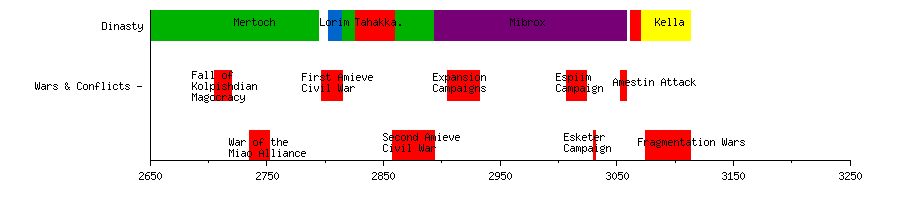
History
Mertoch Dinasty (2650-2821)

Casm was chief of the Mertoch tribe, who were nomads living in the north-eastern Siemetv. In the years 2640-2645 she united other Mecim tribes of the eastern Siemetv. She signed protection contracts with the Miao villages in the canyons and cities along the coast of the Siemetv. Most importantly, she conquered the city of Crisiem in 2644, ruled by Nelheska the Siemtelst Archimage. After being defeated Nelheska offered to work for Casm, because the other Archimages would not have let him settle elsewhere. With the power of an Archimage on her side Casm expanded her territories along the coast of the Siem Sea. She finally settled in 2650 in a new city, Amievimmia.
The Amieve Empire followed primogeniture inheritance during most of its history, her son Casm II inherited the Empire in 2680 and continued the expansion of the Amieve Empire by conquering Habreskeha and killing Telm III (Kolpishdian Archimage) in 2720. Casm II gave the captured Crom to Cofmi an apprentice of Alarn. This sparked a conflict with the other Miao Archimages. They decided to create a new Crom which was granted to Garanov, a mage who lived in the city of Hassi (on an island in the Siem Sea). In 2723 Sav was annexed

At the death of Casm II (in 2735) war erupted between the newly formed Hasmiao Magocracy and the Amieve Empire. Hasmiao had total naval dominance in the Siem Sea and Amieve cities on the coast had their trade stopped. Hasmiao successfully took all the Siem southern coast by 2740 but was unable to advance further. Hasmiao was joined by most of the Miao people across the Siemetv. The city-states of Klarm lake, Snemiao, Tomisne, Vomiao, Tassam, Nafafamio joined the war on Hasmiao's side. While Amieve called for their allies: Urumiao, Sermio and various nomad Bossiem and Nassiem tribes. In 2747 Amieve retook the Siem southern coast, defeating Hasmiao. However the war continued around Klarm Lake, until 2752. As a reprisal Amieve razed the cities of Klarm Lake (except Urumiao). The war ended with Amieve victory and the annexation of the territories around Klarm Lake to the Empire.
Mieir Rule and First Civil War (2790-2858)
In the following decades the priests and monks of the temples around Klarm Lake became extremely powerful. The Great Priest of Mieir became a permanent advisor to the Emperor. In 2790, Siemtiemieir II inherited the Empire when only 5 years old. The Great Priest of Mieir acted as regent and was able to shift the power away from the Emperor and the Mertoch Family. Bossiem tribes that were under the Empire were the most discontent of this situation. They laid siege the temple of Mieir in 2798 but were unable to take it, they abandoned the siege in 2803. They moved to Amievimmia, the city and the Emperor guards surrendered with not much resistance. Most of the Bossiem tribes were still loyal to the Mertoch. However, Pucnoi the great chief of the Lorim tribes entered first in the palace and killed the young Emperor. Pucnoi declared himself emperor, he managed to get some tribes on his side and to drive out the other Bossiem tribes. The Amieve Empire fell in a general civil war, with on one side the Lorim, on another the Great Priest of Mieir, on another one the tribes still loyal to the Mertoch and on top of this multiple warlords took portions of the empire under their control. By 2805, Pucnoi was able to retake control of most of the previous territories of the Empire, except of Klarm Lake and Habreskeha. The Mertoch tribe and their allies fell back in Nassiem territory.
In 2811 Mieir Clergy struck a pact with the Mertoch, they would help to restore a Mertoch Emperor on the throne, but all decisions had to officially go through Great Priest. With the funds available to the Mieir Clergy and the influence of the Mertoch tribe it was easy to sway the war in their favor. In 2815, Pucnoi was defeated and the Lorim tribe were systematically enslaved. Opnarib-Mieir of the Mertoch became Emperor. In the following years the Mieir Clergy fully took control of the Empire. Sapnava-Mieir-Klarmoyu, the Mieir temple-citadel on Klarm Island became effectively the second capital of the Empire.
Yevinnam II, rising to the throne in 2824 tried to retake in her hands control over the Empire. However the Mieir Clergy (probably falsely) accused her of having raided a temple during the civil war. She was exiled in 2826, the Mieir Clergy declared that the Mertoch line was tainted by Mere and was not fit to lead the Empire. To choose the following Emperor the Great-Priest of Mieir declared that the Emperor would be the one most blessed by Mieir. In practice, the one that made the greatest offering to the temple. The Tahakkamaovi tribe (one of the Liecie Nations) from the Eastern Siemetv, was able to offer to the temple the loot they had gained from raiding Tramme. Thus Jaratenuperx the Tahakkamaovi Great Chief became Emperor, by now the title was practically ceremonial. The Emperor title was now passed down following standard Liecie succession, so the eldest sibling always inherited first. In the following decades most of the taxes of the Empire went to Sapnava-Mieir-Klarmoyu, the Great Temple was rebuilt in an opulent architecture. It soon became the largest temple on Miavegr at the time. While the Mieir Priests lived luxurious lives, famines struck most of the Empire, the cities were most affected. Large previously settled population, took again into a nomad lifestyle but this generated frictions with other tribes and pushed them to raid others territories. The Mieir Clergy was effective in maintaining their supremacy by fear of divine punishment and by pitting tribes against each other.
Second Civil War (2858-2894)
In 2858 the unrest grew in the southern Siem and Yevinnam II, still in exile, took the opportunity. She conquered the coast between Sav and Habreskeha and affirmed being the true Emperor. She declared that the Mieir Priests had betrayed the will of Altam and promised to allied tribes to loot the Sapnava-Mieir-Klarmoyu. This second civil war culminated in 2860 when Yevinnam II took Amievimmia. The war then froze, because of the fortified positions of the Mieir Clergy in Klarm Lake. The situation stalled until 2892 when Klarm monasteries rebelled and let Arimecim tribes get to Klarm Island with their ships . The Sapnava-Mieir-Klarmoyu was sacked, but left standing. The current Emperor, Casm III retook all of Klarm in 2893 but when it was discovered that Mieir Great Temple had already been sacked, the tribes saw their promise broken and revolted against the Mertoch Emperor. Casm III lost his final battle in Eviridim and was killed there. The tribe chiefs of the Empire gathered and voted for the Mibrox noble Passunvelez to become Emperor in 2894.
Mibrox Dinasty, Golden Age (2894-3053)

Passunvelez on one side focused on centralizing power and organizing the Empire in principalities, while on the other he started multiple expansion campaigns. Between 2905 and 2911 he conquered Sermio, Nafafamio and Talmumi. Then he expanded the borders east along the Upper Mibfoc. He founded Otucnes as a fortess-city on the river. His successor, Mibrosiem, launched an attack on the Hasmiao magocracy in 2932 taking their eastern territories and the city of Vordiem. The following century was mostly peaceful: a border was fixed with the Xao Empire. To facilitate commerce south, with the Malacin Empire, the trade routes were secured with allegiance pacts with various tribes and the construction of the cities of Ugribres, Sarmiut and Rapketes. With the same scope in 3007 the Amieve Empire started a campaign against the Sugimmian Oligarchy and their allied Nassiem tribes, which had control of the trade route between the regions of the Siemetv and Mimia. The Empire quickly captured the city of Siemia, which was still in construction, but was held off in Assugi. During the following decade the Amieve Empire armies disrupted caravans from Sugimmia. This slowly strained relations between the noble families in the coastal city. Thanks to this the Amieve Empire was finally able to take Assugi and then Sugimmia in 3018. The Emperor Tanumellov, to further stabilize his power in the region, moved the capital to Sugimmia. This helped with the following conquest of the rest of Espiim Peninsula (Espinao Kingdom) in 3023. The Amieve Empire attained its greatest expansion in 3032 with the conquest of the High Esketer from Ketmiac tribes (Somias Principality). During these decades the Amieve Empire was at the peak of its Golden Age. However this abruptly ended in 3053.
Fall (3053-3113)
In 3053 the newly formed Amestin Empire launched an attack on Espiim, they took most of the peninsula but the city of Sugimmia was too well fortified and guarded. The siege lasted for five years, there were still no signs of struggle on Amieve side while the Amestin were reconsidering continuing the siege. However, in 3058 when Mibrosiem III, the Amieve Emperor, tried to secretly flee the city of Sugimmia, she was spotted by the Amestin vanguard and killed. Following this, Amieve army was in disarray and the city was taken by Amestin. They imprisoned the Mibrox family and took full control of Espiem. In Amievimmia, there was no successor related to Mibrosiem III, multiple tribe chiefs affirmed their family connections to the Mibrox. There were some conflicts in the Empire, however the Princes intervened and placed Plirplirkas Tahakkamaovi on the throne in 3062. Following this, the Princes obtained more independence and the Emperors lost most of their centralized power. Receiving lower taxes from the Princes the Emperor raised the tributes asked from nomad tribes in 3071. A first war took place between 3075 and 3080, multiple tribes were able to regain independence. In 3087 the Hasmiao Magocracy attacked the Empire and took its western territories. Lastly after 3110 the Empire began to fragment, the Princes did not acknowledge the authority of the Emperor. By 3110, the nomad tribes and the Princes began attacking caravans and raiding the cities on the Siemetv plateau, most were razed and not reconstructed after. The tribes of the northern Siemetv were the most active in the conflict, in 3113 the Effi tribe entered Amievimmia and killed Sormax, the last Emperor of Amieve. The Effi tribe chief declared herself king of Amieve, but had control over a much smaller territory and there was no continuity with the Amieve Empire institutions.
Subdivisions
In the first centuries of the Empire its borders were fluid and its internal politics were structured around tribes and towns directly swearing fealty to the Emperor. The rulers under the emperor mostly had power over people and not a defined territory. Until the end of the Second Civil war, warlords and the Mieir clergy undercut the authority of the Emperor. The Emperor received a small part of taxes and civil wars were prone to happen often. To solve this Passunvelez, between 2899 and 2911 elevated multiple tribe chiefs/noble family heads to the rank of Prince, giving them a fixed territory and demanding taxes directly from them. Following the creation of these first principalities, new ones were created with the expansion of the Empire. The Emperor always had a say in the succession of the title of Prince but often following each principality tradition. Most often the title was inherited by a successor designated by the previous prince or the result of an auction between noble families.
Government
The Amieve Empire was an empire the Emperor had nearly absolute power. However tribe chiefs and could petition the Emperor, but the demands could be easily refused.
List of Emperors
| N | Emperor Name | Reign | Life | Dinasty |
|---|---|---|---|---|
| 1 | Casm | 2650-2680 | 2627-2680 | Mertoch |
| 2 | Casm II | 2680-2735 | 2648-2735 | Mertoch |
| 3 | Yevinnam | 2735-2750 | 2691-2750 | Mertoch |
| 4 | Siemtiemieir | 2750-2790 | 2733-2790 | Mertoch |
| 5 | Siemtiemieir II | 2790-2794 | 2785-2803 | Mertoch |
| 6 | Pucnoi | 2803-2815 | 2783-2818 | Lorim |
| 7 | Opnarib-Mieir | 2815-2824 | 2786-2824 | Mertoch |
| 8 | Yevinnam II | 2824-2826 | 2788-2871 | Mertoch |
| 9 | Jaratenuperx | 2826-2832 | 2741-2832 | Tahakkamaovi |
| 10 | Nobienperx | 2832-2835 | 2743-2835 | Tahakkamaovi |
| 11 | Jaratenuvin | 2835-2847 | 2751-2847 | Tahakkamaovi |
| 12 | Plirplirvin | 2847-2849 | 2752-2849 | Tahakkamaovi |
| 13 | Nobientes | 2849-2860 | 2772-2868 | Tahakkamaovi |
| 14 | Yevinnam II | 2860-2871 | 2788-2871 | Mertoch |
| 15 | Casm III | 2871-2894 | 2810-2894 | Mertoch |
| 16 | Passunvelez | 2894-2921 | 2872-2921 | Mibrox |
| 17 | Mibrosiem | 2921-2967 | 2901-2967 | Mibrox |
| 18 | Mibrosiem II | 2967-2986 | 2921-2986 | Mibrox |
| 19 | Opnarib-Miut | 2986-2991 | 2949-2991 | Mibrox |
| 20 | Tanumellov | 2991-3032 | 2976-3032 | Mibrox |
| 21 | Mibrosiem III | 3032-3058 | 3019-3058 | Mibrox |
| 22 | Plirplirkas | 3062-3071 | 3041-3071 | Tahakkamaovi |
| 23 | Tevenessi | 3071-3109 | 3054-3109 | Kella |
| 24 | Sormax | 3109-3113 | 3099-3113 | Kella |


