Mialof Republic: Difference between revisions
No edit summary |
|||
| (89 intermediate revisions by the same user not shown) | |||
| Line 1: | Line 1: | ||
<div style="float: right;"> | <div style="float: right;"> | ||
{{Wikibundi:WikiProject_Transwiki/Template:Infobox | {{Wikibundi:WikiProject_Transwiki/Template:Infobox | ||
|bodystyle=background-color:#F8F9FA;border:solid 2px #A2A9B1 | |bodystyle=background-color:#F8F9FA;border:solid 2px #A2A9B1 | ||
|title= | |title=Mialof Republic | ||
|image=[[File: | |image=[[File:Mialof_Flag.png|200px|4046 State flag]] | ||
|titlestyle=background-color:#D6D6D6; | |titlestyle=background-color:#D6D6D6; | ||
|headerstyle=background-color:#D6D6D6; | |headerstyle=background-color:#D6D6D6; | ||
|datastyle=float: right; | |datastyle=float: right; | ||
|label1=Official Name | |label1=Official Name | ||
|data1=<div style="float: right;">'' | |data1=<div style="float: right;">''Sires Miaoltife Nirtafe Tulesni Saliavesmiao Mialofeo ''<br> | ||
<small>( | <small>(Sacred Mialof Republic of Miaolti and Nirta)</small></div> | ||
|label2= | |label2=Capitals | ||
|data2= | |data2=Miaolti and Nirta | ||
|header3=Languages | |header3=Languages | ||
|label4=Administrative | |label4=Administrative | ||
|data4= | |data4= Molpelsh | ||
|label5=Liturgical | |label5=Liturgical | ||
|data5=Archaic Miao | |data5=Archaic Miao | ||
|header6=Government | |header6=Government | ||
|label6=<br> | |label6=<br> | ||
|data6= | |data6= Democratic-Plutocratic Mixed Republic | ||
|header7=Religion | |header7=Religion | ||
|label7=[[Miaopiaoism]] | |label7=[[Miaopiaoism]] | ||
|data7= | |data7= | ||
<div style="float: right;"> | <div style="float: right;"> | ||
*Aithran Orthodox <small>( | *Elessenism<small>(major)</small> | ||
*Aithran Orthodox <small>(major)</small> | |||
*Semor Nador Dualism <small>(accepted)</small> | *Semor Nador Dualism <small>(accepted)</small> | ||
* | *Lumiai-Ucci Neogenesism<small>(accepted)</small> | ||
*Tuiretovism<small>(accepted)</small> | |||
*Miaopiao Traditionalism <small>(accepted)</small> | *Miaopiao Traditionalism <small>(accepted)</small> | ||
</div> | </div> | ||
|header8=Currency | |header8=Currency | ||
|data8= | |data8=Moffilerist | ||
|header9=Population (in 4046) | |||
|data9= 157 234 000 | |||
}} | }} | ||
</div> | </div> | ||
The | The Mialof Republic (also called Miaolti Republic), was a state ruling over territories mostly in eastern Miaotir, it also controlled northern Tluctir and had colonies in the north of Miaotir and Accriem. It was founded in 3526 after the Flaming Barge Revolution. It controlled most of the maritime commerce in the world through the Companies. It was one of the most influential states of its time.<br> | ||
< | <br> | ||
< | <br> | ||
< | <br> | ||
< | <br> | ||
< | <br> | ||
< | <br> | ||
< | <br> | ||
< | <br> | ||
< | <br> | ||
< | <br> | ||
< | <br> | ||
< | <br> | ||
< | <br> | ||
< | <br> | ||
< | <br> | ||
< | <br> | ||
< | === Timeline=== | ||
===Timeline=== | |||
---- | ---- | ||
<div class="below-content"> | <div class="below-content"> | ||
| Line 63: | Line 63: | ||
DateFormat = yyyy | DateFormat = yyyy | ||
Period = from: | Period = from:3500 till:4100 | ||
TimeAxis = orientation:horizontal | TimeAxis = orientation:horizontal | ||
ScaleMajor = unit:year increment:100 start: | ScaleMajor = unit:year increment:100 start:3500 | ||
ScaleMinor = unit:year increment:100 start: | ScaleMinor = unit:year increment:100 start:3550 | ||
| Line 73: | Line 73: | ||
Define $dy2 = 0 | Define $dy2 = 0 | ||
BarData= | BarData= | ||
bar:dyn text: | bar:dyn text:Periods | ||
bar:events text:Events | bar:events text:Events | ||
bar:title_war | bar:title_war | ||
barset:war text:External_Wars | barset:war text:External_Wars | ||
bar:civil text:Civil_Wars | bar:civil text:Civil_Wars | ||
bar:title_prc | bar:title_prc | ||
barset:p | barset:p text:"Territorial gains" | ||
PlotData= | PlotData= | ||
bar:title_war color:yellow align:center anchor:middle shift:(0,-5) text:"Wars" fontsize:XL from:start till:end | bar:title_war color:yellow align:center anchor:middle shift:(0,-5) text:"Wars" fontsize:XL from:start till:end | ||
bar:dyn align:left fontsize:S | bar:dyn align:left fontsize:S | ||
from: | from:3519 till:3526 shift:(-30,10) text:"Flaming~Barge~Revolution" color:blue | ||
from: | from:3526 till:3593 shift:(-20,10) text:"Rise~Over~Mages" color:pink | ||
from:3593 till:3639 shift:(-20,10) text:"Peace~Of~Eles" color:red | |||
from: | from:3639 till:3796 shift:(-20,10) text:"War~and~Reform" color:skyblue | ||
from: | from:3796 till:4000 shift:(-20,0) text:"Urris_Peace" color:yellow | ||
from: | bar:events align:left fontsize:S color:black mark:(line,black) | ||
at:3532 shift:(-30,10) text:"Death~Of~Nelasia" color:black | |||
at:3546 shift:(-20,10) text:"Overseeing~Tribunal" color:black | |||
at:3597 shift:(-30,10) text:"Lixao~Alliance" color:black | |||
at:3615 shift:(-20,10) text:"Eles~Accords" color:black | |||
at:3681 shift:(-40,10) text:"Rubliei~Reform" color:black | |||
at:3688 shift:(5,10) text:"Irrigation~Edicts" color:black | |||
bar:events align:left fontsize:S color: | |||
at: | |||
at: | |||
at: | |||
barset:war color:red mark:(line,white) align:center fontsize:S | barset:war color:red mark:(line,white) align:center fontsize:S | ||
from: | from:3521 till:3593 shift:(0,10) text:"Early~Mirmiao~Conflicts" color:red | ||
from:3526 till:3532 shift:(0,10) text:"War~of~Independence" color:skyblue | |||
from:3537 till:3593 shift:(0,10) text:"War~with~Aoner" color:skyblue | |||
from: | |||
from: | |||
barset:break | barset:break | ||
from:3660 till:3673 shift:(0,10) text:"Struggle~in~Ziho" color:pink | |||
from: | |||
barset:break | barset:break | ||
from:3705 till:3732 shift:(0,10) text:"Amestin~Succession~War" color:pink | |||
barset:break | barset:break | ||
from:3752 till:3758 shift:(0,10) text:"Late~Mirmiao~Conflicts" color:red | |||
bar:civil | |||
from: | from:3642 till:3647 shift:(0,10) text:"Treacherous~Revolts" color:green | ||
from:3675 till:3681 shift:(0,10) text:"Two~Senates~War" color:green | |||
barset:break | barset:break | ||
at: | barset:p color:red mark:(line,black) align:center fontsize:S | ||
at: | at:3539 shift:(-20,10) text:"Zontiao~Birbor" color:black | ||
at:3557 shift:(-20,10) text:"Pommio" color:black | |||
barset:break | barset:break | ||
at: | at:3565 shift:(-20,10) text:"Kiaovim~Teppem" color:black | ||
at:3593 shift:(-20,10) text:"Niacci~Listia" color:black | |||
barset:break | barset:break | ||
at: | at:3639 shift:(-20,10) text:"Biaofan" color:black | ||
at: | at:3673 shift:(-20,10) text:"Viplis" color:black | ||
barset:break | barset:break | ||
at: | at:3711 shift:(-20,10) text:"Nemibfo" color:black | ||
at: | at:3727 shift:(-20,10) text:"Molpio" color:black | ||
at: | at:3732 shift:(-20,10) text:"Ippur~Colony" color:black | ||
barset:break | barset:break | ||
at: | at:3861 shift:(-20,10) text:"Tollovezn~Colony" color:black | ||
at:3999 shift:(-20,10) text:"Triffjord~Colony" color:black | |||
barset:break | barset:break | ||
at: | at:4020 shift:(-20,10) text:"Miltu" color:black | ||
at: | at:4027 shift:(-20,10) text:"Raxiem" color:black | ||
</timeline> | </timeline> | ||
| Line 216: | Line 138: | ||
===History=== | ===History=== | ||
---- | ---- | ||
====''' | ===='''Flaming Barge Revolution (3519-3526)'''==== | ||
[[File: | [[File:Elesmiao3519.png|thumb|434x434px|The Elesmiao magocracy, in 3519 before the Flaming Barge Revolution]] | ||
The [[Elesmiao Magocracy]] had controlled the Mibfoc Valley for more than a thousands years, however by 3519 it had grown weak. The [[Siemetv Great Clan]] had conquered most of the Atram principalities in the west, it sent repeated incursions through the borders plundering Tibecia and Bist. While the [[Archimage]] armies were occupied in the west, the merchants of the cities of Miaolti, Nirta and Vesbomio organized a revolt. They were unhappy of the high taxes , the absolute control of river trade by the Archimage and the imposed halt in the works for the canalization of the Mibfoc river. Nelasia, the Archimage, had been ruling for only three years and had made trading deals with the Aoner Magocracy and the [[Amestin Empire]] practically giving them full control of ocean trading routes. | |||
The merchants of the three cities sought the help of the Macrom and Robimecim slaves that worked in the cities and the Miaolti, Vonzie (Vesbomio) and Vivimbimi (Mibfiao) Principalities (dependent of the magocracy). Other Robimecim tribes fleeing the Great Clan of the Siemetv from the Voditram Principality (independent), attacked the north-western cities of Acaviao and Gidiao. In 3520, the merchants used incendiary barges to sink the Archimage's river fleet in Nirta. This allowed them to take full control of Miaolti and Nirta. The Archimage fled to Zontiao, taking all of its armies that weren't holding the western border from the Great Clan. | |||
[[File:Elesmiao3526.png|thumb|440x440px|The Mialof Republic at its foundation in 3526]] | |||
Vesbomio was still controlled by the Prince of Vonzie in 3521, when the Robimecim tribes set siege at the city and took it one year later helped by the merchants and slaves inside the walls. However the Vonzie Prince let the [[Mirmiao]] tribes in from the north, in 3522 they conquered Vesbomio and then Nirta. Most of the rebelled population, from both cities, were taken to the Great Temple of Mir and sacrificed to the divinity. In the mean time, the Miaolti Prince took back his city, while the remaining rebels fled to the Macrom tribes territories, where the Archimage's force had been expelled. The same year the Northern and Miltu Principalities seceded from the Magocracy. | |||
In the west the Great Clan of the Siemetv had launched another offensive, quickly taking Tibecia, Acaviao and burning Bist. They continued advancing in the following years taking Gidiao, Viplis and Biaofan. Until 3525 when the allied forces of the Aoner and Elesmiao Magocracies stopped the attack on Eskola and destroyed most of the Great Clan armies. | |||
In 3525, the rebel forces marched again on Miaolti killing the Prince and conquering the city. They went up the Mibfoc river and conquered Nirta. They faced the Elsemiao and Aoner armies in Mibfiao and sieged the city taking it in 3526. The Mialof Republic was founded the same year, with the creation of the River Senate in Miaolti and the Lands Senate in Nirta. The provinces of the newborn republic were, at its foundation: | |||
===='''Rise Over Mages (3526-3593)'''==== | |||
After 3526, the Elesmiao Magocracy held only on the eastern territories, all the others having taken their independence or being under control of the Mialof Republic. The war between the Magocracy and the Republic continued until 3532, when the Archimage Nelasia went to the Eles Theocracy (that had a neutral stance in the war) and participated in the ceremonial bathing in the Great Temple of Eles. However, the water had been poisoned by the priests, the Archimage died, while the chosen successor died while traveling to the western Simetv to tame a dragon and be the new Archimage. The Archimage Council voted in 3535 to let the Mialof Republic choose the successor. A referendum was organized and Marcrat of Tillalti was chosen as Archimage. The Republic then started a campaign against the Maomir Kingdom, they were able to retake Vesbomio in 3537 and fully conquer it in '''3538'''. | |||
In the following years the Republic fully took control of the Mibfoc river from the Aoner Magocracy. Zontiao in 3539 was taken from the Aoner Magocracy. but for the river delta that remained under control of the Amestin Empire. In 3540 they founded the city of Crodola on the border, and began expanding their oversea commerce, with the release of the first Sea Commerce Permits by the River Senate. | |||
In '''3546''' the Foundation Council, restructured the government. The Overseeing Tribunal was created in Vesbomio. The first 56 High Judges wrote the Way-Chart, settling the functioning of the republic. | |||
The Aoner Archimage allied in 3557 with the remaining Mirmiao tribes, they reconquered the Maomir territories but were stopped and defeated at the walls of Vesbomio by the Republic Armies, notably with armies from Pommio (recently freed from the Ponpi Principality). | |||
In the following years the territories of the Republic expanded; in 3565 the Kiaovim and Teppem Republics were annexed. In 3582 the Republic attacked again the Aoner Magocracy. They were helped by the Nofmac tribes from inside the magocracy. Thanks to this double front attack, the Archimage was defeated in '''3593''' and forced to step down. With this, Niacci, Listia and other cities of Miaotir eastern coast were under Mialof control, which gave them the capability to even further expand their long distance trading. | |||
[[File:Mialof3593.png|thumb|455x455px|The Republic before the Peace of Eles in 3593]] | |||
==== '''Peace Of Eles (3593-3639)''' ==== | |||
The new republic stabilized its territories with an alliance with the Lixao Empire and the [[Urris Empire]]. The Peace of Eles saw only minor skirmishes mostly with Maomir, the Siemetv Great Clan. | |||
In 3615 the Elessian Accords were signed: the Eles Theocracy ceded its northern territories to the Republic, but was granted perpetual ownership of its temples and monasteries across the Republic. | |||
==== '''War and Reform(3639-3796)''' ==== | |||
In the year 3639 the city of Biaofan, and neighboring territories were conquered from the Ixmac principality. | |||
In '''3642''' the Lands Senate secretly supported peasant militias in the eastern provinces to undermine the power held by local companies over the region. However most rebellions were unsuccessful. In 3645 the role of the Lands Senate was discovered and the Traitor's Court ordered the execution of 54 Lands Senators, this prompted new revolts in their provinces. To quell them, the tribunal retracted its decision in 3647 (however 23 had already been executed). | |||
In 3660 the principalities of the Zihò (Ladivon, Ixmac, Ixtec, Atlivi, Miaran, Zimuhò) allied against the republic, the Republic turned the war around, Viplis was conquered in 3673 ending the conflict. | |||
This last war was extremely costly for the republic and highly unpopular. The military decisions were, at that time, made by the Rivers Senate because it functionally held executive power. The Lands Senate wanted a place in these decisions, however this was refused. This argument degenerated in a civil war, when the Overseeing Tribunal ruled in favor of Nirta in '''3675'''. Two Generals supported Nirta, two supported Miaolti and two stayed neutral, the admiral of the River Fleet supported Miaolti. This allowed the Rivers Senate to enter Nirta in 3676, they burned the Lands Senate. However their armies couldn't take control of the city. They had to withdraw from the city. In the following years the civil war expanded to most of the republic. With popular militias supported by Nirta clashing with the private armies of rich merchants. The war continued until '''3681''' when a peace agreement was signed in Rubliei. The Lands Senate agreed to create the Bounding Assembly, in which the Lands Chancellor had a seat. This settled the conflict over executive power. | |||
In '''3688''' an economic crisis shook the republic, poverty rose and famines became common. This prompted the Lands senate to create special measures for companies to finance relief. These laws were known as the ''Irrigation Edicts''. | |||
In '''3705''' the Republic joined the Amestin succession war, on Stoluu side, because the Emperor promised them Nemibfo and Molpio. So they attacked the territories controlled by their opponent, Tufnuskaras. To coordinate the campaign, the Military Authority was created. They first defeated him in Nemibfo in 3711, taking control of the Mibfoc delta. The Republic launched a new offensive against the Zihò principalities, taking the pass to the Molpio peninsula. Thus in 3727 they were able to attack Molpio from land and sea, taking the city. Finally, in 3732, the united fleets of Stoluu and the Republic defeated Tufnuskaras in Ippur. Admiral Anyust took control of Ippur as his personal territory, founding Ippur Colony. | |||
In 3752 after the forced conversion and resettlement of more and more Mirrenist tribes inside the Republic,.they began living outside of the Republic institutions. Their use of private land and the vast wood that could be harvested from the forests in Maomir territory, was what triggered the Republic reaction. In response the Republic invaded the Maomir Kingdom, burned Mirmiao and pillaged the Great Temple of Mir with the help of the Count of Dan. | |||
[[File:Mialof 3796.png|thumb|543x543px|Mialof Republic just before the Urris peace]] | |||
==== '''Urris Peace (3796-4000)''' ==== | |||
During Urris Peace, Mialof was granted in multiple occasions exceptions to the frozen border agreement. | |||
It first annexed the Northern Principality in 3840. Then the Erdiao principality in 3847. Lastly the Ixmac principality in 3971. | |||
The Republic also occupied ( with the agreement of Urris) the northern Tulcsavem territories in 3983. | |||
The republic also created two colonies in the north thanks to the Ice Fleet gifted by Urris. The Tollovezn Peninsula Colony was founded in 3861. The Triffjord colony in 3999. | |||
==== '''????(4000-?)''' ==== | |||
After the fall of Urris, the Mialof Republic started a process of annexation of dependent territories. In 4000 already, the Free Macrom Tribes willfully beacame a province of the Republic. In 4020 the special status of some provinces, where the local nobility kept some local power, was lifted. This sparked some rebellions but they were swiftly quelled. With this reform the gradual annexation of Miltu principality was started. | |||
[[File:Mialof 4047 (Large).png|thumb|535x535px|Mialof Republic in 4047]] | |||
With the political situation becoming more unstable the Loam, Jidac, Nofmac, Udiaecim, Recim, Libiume, Timie tribes all joined the Republic in the following decade. | |||
In 4027 the Frisseln-Kenao Company bought Raxiem city, thus it bacame part of the Republic. | |||
In 4037 the Republic conquered part of Ixinde , helped by Antaxi County. | |||
=== Subdivisions === | |||
----In 4046 the Mialof Republic was subdivided in 2 Capital Cities (Miaolti, Nirta), 8 Great Cities (Vesbomio, Pommio, Lestimio, Eskola, Crodola, New Listia, Mibfiao, Biaofan), 64 Provinces and 4 Colonies (Ippur, Puvmizo Islands, Triffjord, Tollovezn Peninsula). | |||
The Colonies had special administrations. Ippur was governed by an Admiral; while Puvmizo Islands and the Triffjord by a Governor. The place of Governor was given to the highest bidding company every 8 years. Tollovezn Peninsula was the private property of Frisseln-Kenao Company. | |||
[[File:Mialof Provinces.png|center|frameless|1173x1173px]] | |||
==== '''Provinces''' ==== | |||
{| class="mw-collapsible mw-collapsed wikitable" | |||
|+ List | |||
|- | |||
! West | |||
!Center | |||
! South | |||
!East | |||
!North | |||
|- | |||
| Pundea | |||
|Robb-Robset | |||
| North Juzmalgi | |||
|Ihest | |||
|Simmiao | |||
|- | |||
|Robimech | |||
|Skelper | |||
|South Juzmalgi | |||
|Delta | |||
|Simmi-Miltu | |||
|- | |||
|Mahdren | |||
|Vesmbi | |||
|Yiguhonne | |||
|Mammiobirbia | |||
|Tiscins | |||
|- | |||
|Inziao | |||
|Parcasanna | |||
|Banks of Ixen | |||
|Lower Mibfoc | |||
|Clarsubex | |||
|- | |||
|Mistich | |||
|Vonzie | |||
|South Ixmac | |||
|Vmiarkil | |||
|Ftestitere | |||
|- | |||
|Udiana | |||
|Pazka-Purve | |||
|North Ixmac | |||
|Nofmasia | |||
|Cupellurch | |||
|- | |||
|Esketer | |||
|Confluence | |||
|Lerimiao | |||
|Birbor | |||
|Lesti | |||
|- | |||
|Vimbi | |||
|Ponpi | |||
|Afam | |||
|Vlesh | |||
|Ezim-Lazzam | |||
|- | |||
|Recimisia | |||
|Outer-Mib | |||
|Groapertini | |||
|Faony | |||
|Nellin-Lazzam | |||
|- | |||
|Jirissia | |||
|Drevvelania | |||
|Moagmesia | |||
|Navatmio | |||
|Erdiao | |||
|- | |||
|Vapanch | |||
|Macrosia | |||
|Disdovila | |||
|Zimianta | |||
|Vanka-Pess | |||
|- | |||
| | |||
|Loammasia | |||
| | |||
|Island of Na | |||
| | |||
|- | |||
| | |||
|Gaoga-Beoli | |||
| | |||
|Maozim | |||
| | |||
|- | |||
| | |||
|Annama-Maxia | |||
| | |||
|Ferfemao | |||
| | |||
|- | |||
| | |||
|Svopeboro | |||
| | |||
|Tulcasia | |||
| | |||
|- | |||
| | |||
| | |||
| | |||
|Tapalloeul | |||
| | |||
|} | |||
=== Government === | |||
----The main feature of the Mialof state from its foundation, a democratic-plutocratic mixed republic, was the separation of power between the Lands Senate and the River Senate. These two institutions gathered the legislative and part of the executive power. The Vesbomio Overseeing Tribunal, created in 3546, it oversaw all tribunals across the republic and held cases between large corporations or regarding the government. Later institutions, were the Bounding Assembly (created in 3681) and the Military Autority (created in 3705). The power of these different bodies varied throughout history but they mostly kept relatively distinct roles. | |||
==== '''Lands Senate''' ==== | |||
The Lands Senate gathered in Nirta and was composed of senators for each province. Each Province elected at least one senator, with additional senators every 200.000 citizens in the province. The Colonies had always only one ( Governor's ) Representative, they didn't always have the same powers as senators and weren't elected (the land senate also had a limited or no power over the Colonies). Overall, this Senate was composed of more than 500 Senators and 4 Representatives. | |||
The Lands Senate elected a single Chancellor, to oversee the senate and take part in the Bounding Assembly. | |||
The Lands Senate had legislative power over the citizens (rights, education, justice, health...) and lands (land-use, province organization, roads, public infrastructure) of the Mialof Republic. | |||
The power was highly centralized and the Provinces had only a very limited authority. Inside each Province the senators chose the members of the Provincial Assembly, that held the executive power at the Provincial level. However the Great Cities elected their own Urban Senate (that appointed the Land Senators) that had a limited legislative power. | |||
==== '''Rivers Senate''' ==== | |||
The Rivers Senate was composed of 6 standard chambers of 30 members, for each official production type: | |||
* Harvest (agriculture, husbandry) | |||
* Extraction (mines, forestry) | |||
* Wilds (hunting, fishing) | |||
* Crafts (artisans, metallurgy) | |||
* Symbols (banks, culture) | |||
* Construction (building, infrastructure) | |||
These Chambers were made of senators elected between and by all citizens that payed more than the High Threshold in state taxes. Moreover, you had to possess a business in the right field to be elected or cast a vote for a Senator in a given Chamber. If someone had more than one different business, they could only cast one vote in the Chamber of their choosing. However, the citizens that could vote, could choose any Chamber they wanted. An additional Chamber, the '''Shipping Chamber''', was composed of Deputies of all the corporations holding Oversea Shipping Permits. Each Deputy had a voting power of 1/30<sup>th</sup> of all the senate. In all, the Rivers Senate was made of 180 Senators and most often between 5-20 Deputies. | |||
Each Chamber elected a Chancellor, they had veto powers over most decisions and were part of the Bounding Assembly. | |||
The Rivers Senate had legislative power over the economy, companies and state budget. | |||
==== '''Overseeing Tribunal''' ==== | |||
The Vesbomio Overseeing Tribunal, was the central justice body of the Mialof Republic. It was composed of 56 High Judges randomly chosen from the pool of eligible citizen. A citizen was eligible if: they had a Law Degree given by a certified University, they had held any political or judicial position for at least 20 year, and the citizen had cast their name, with a sphere, in the '''Silver Box''' in Vesbomio, when one of the 56 judges died (or abdicated or was in any other way prevented from exerting their function) a sphere was taken at random from the box and the new judge was chosen. The judge was appointed for life, but could abdicate at any moment, however if so they could not cast their name again in the Silver Box. | |||
The Overseeing Tribunal was structured in Courts. There were four courts in Vesbomio: | |||
* The High Court settled state level disputes (mostly between the senates) | |||
* The Commerce Court settled money disputes (between large companies) | |||
* The Military Court settled disputes against the military | |||
* The Traitor's Court settled criminal cases that impacted strongly the Republic | |||
The oldest High Judge received the title of President of Justice (the head of the Overseeing Tribunal). They chose two other High Judges to oversee the High Court. The other High Judges were dispatched to the main courts of the Republic, there they could appoint judges to oversee provincial courts. | |||
All the High Judges were called to Vesbomio High Court in case of larger scale disputes in one of the four Courts. They could also assemble in Vesbomio if one of the Senates remarked an inconsistency with legal interpretation between different provinces. | |||
The High Judges were also responsible of the respect of the '''Way-Chart'''. This constitution like set of laws described the fundamental principles of the Republic and the rights/duties of its citizens. It could be changed only by unanimous decision of the High Judges. | |||
==== '''Bounding Assembly''' ==== | |||
The Bounding Assembly was composed of : the Lands Chancellor, the 7 Rivers Chancellors, the Military Chancellor, a Continuity Chancellor (elected by the preceding Assembly). The Archimages were part of the Bounding Assembly but only as counsel. The Bounding Assembly held most of the executive power. | |||
==== '''Military Authority''' ==== | |||
It was made of the 6 Generals and 4 Admirals of the Republic. Generals and Admirals chose their successor, however each member of the Bounding Assembly had a right of veto. Moreover the Military Court could strip any military officer of their rank. They voted between themselves for a Military Chancellor that represented them in the Bounding Assembly. Each military leader had an assigned zone of operations. | |||
* General of Vesbomio : their armies guarded the Overseeing Tribunal and executed its decisions. | |||
* General of Nirta: guarded the Lands Senate and the western frontiers. | |||
* General of Ixen: guarded the southern frontier. | |||
* General of Eskola: guarded the western frontier. | |||
* General of Crodola: guarded the eastern frontier. | |||
* General of Lestimio: guarded the northern frontier. | |||
* Admiral of Umpazi: controlled the Ice Fleet | |||
* Admiral of Listia: controlled the Vmia Fleet | |||
* Admiral of Miaolti: guarded the Rivers Senate, controlled the River Fleet | |||
* Admiral of Ippur : ruled over Ippur Colony, controlled the Smia Fleet | |||
The Military Authority made strategic military decisions, however its powers were limited during times of peace. | |||
=== Economy === | |||
----The Mialof republic was from its creation a prosperous country. Its dominated most of oceanic trading, they were extremely present all over Miavegr and monopolized entire trade routes. | |||
Trading was regulated by the Rivers senate, it distributed Oversea Shipping Permits | |||
==== '''Oversea Companies''' ==== | |||
* Two Ocean Trading Company : owned the western trade routes to Gram republic and Mimia subcontinent. | |||
* Listia Euntaox Shipping : traded with southern Gram and Urris | |||
* Greater Ippur Company : traded in Tluctir and Accriem | |||
* Frisseln-Kenao Company : owned the northern trade routes (owned Tollovezn peninsula) | |||
* | |||
[[Category:Politics]] | [[Category:Politics]] | ||
Latest revision as of 16:10, 1 May 2026
| Mialof Republic | |

| |
| Official Name | Sires Miaoltife Nirtafe Tulesni Saliavesmiao Mialofeo
(Sacred Mialof Republic of Miaolti and Nirta) |
|---|---|
| Capitals | Miaolti and Nirta |
| Languages | |
| Administrative | Molpelsh |
| Liturgical | Archaic Miao |
| Government | |
| Democratic-Plutocratic Mixed Republic | |
| Religion | |
| Miaopiaoism |
|
| Currency | |
| Moffilerist | |
| Population (in 4046) | |
| 157 234 000 | |
The Mialof Republic (also called Miaolti Republic), was a state ruling over territories mostly in eastern Miaotir, it also controlled northern Tluctir and had colonies in the north of Miaotir and Accriem. It was founded in 3526 after the Flaming Barge Revolution. It controlled most of the maritime commerce in the world through the Companies. It was one of the most influential states of its time.
Timeline
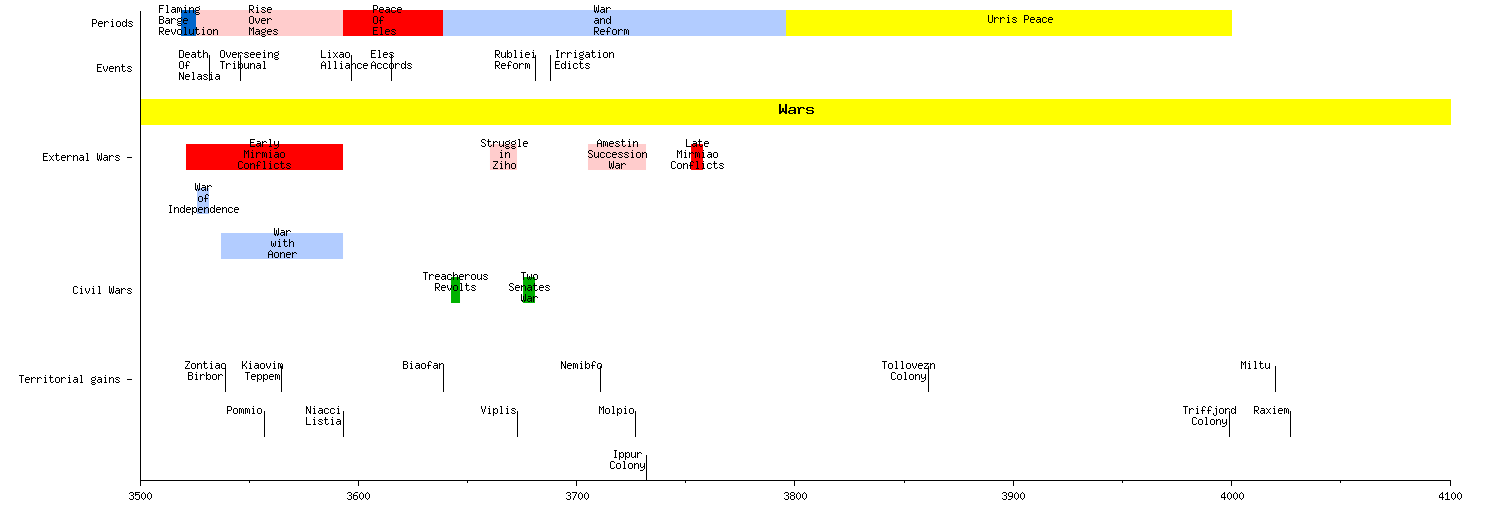
History
Flaming Barge Revolution (3519-3526)

The Elesmiao Magocracy had controlled the Mibfoc Valley for more than a thousands years, however by 3519 it had grown weak. The Siemetv Great Clan had conquered most of the Atram principalities in the west, it sent repeated incursions through the borders plundering Tibecia and Bist. While the Archimage armies were occupied in the west, the merchants of the cities of Miaolti, Nirta and Vesbomio organized a revolt. They were unhappy of the high taxes , the absolute control of river trade by the Archimage and the imposed halt in the works for the canalization of the Mibfoc river. Nelasia, the Archimage, had been ruling for only three years and had made trading deals with the Aoner Magocracy and the Amestin Empire practically giving them full control of ocean trading routes. The merchants of the three cities sought the help of the Macrom and Robimecim slaves that worked in the cities and the Miaolti, Vonzie (Vesbomio) and Vivimbimi (Mibfiao) Principalities (dependent of the magocracy). Other Robimecim tribes fleeing the Great Clan of the Siemetv from the Voditram Principality (independent), attacked the north-western cities of Acaviao and Gidiao. In 3520, the merchants used incendiary barges to sink the Archimage's river fleet in Nirta. This allowed them to take full control of Miaolti and Nirta. The Archimage fled to Zontiao, taking all of its armies that weren't holding the western border from the Great Clan.

Vesbomio was still controlled by the Prince of Vonzie in 3521, when the Robimecim tribes set siege at the city and took it one year later helped by the merchants and slaves inside the walls. However the Vonzie Prince let the Mirmiao tribes in from the north, in 3522 they conquered Vesbomio and then Nirta. Most of the rebelled population, from both cities, were taken to the Great Temple of Mir and sacrificed to the divinity. In the mean time, the Miaolti Prince took back his city, while the remaining rebels fled to the Macrom tribes territories, where the Archimage's force had been expelled. The same year the Northern and Miltu Principalities seceded from the Magocracy. In the west the Great Clan of the Siemetv had launched another offensive, quickly taking Tibecia, Acaviao and burning Bist. They continued advancing in the following years taking Gidiao, Viplis and Biaofan. Until 3525 when the allied forces of the Aoner and Elesmiao Magocracies stopped the attack on Eskola and destroyed most of the Great Clan armies.
In 3525, the rebel forces marched again on Miaolti killing the Prince and conquering the city. They went up the Mibfoc river and conquered Nirta. They faced the Elsemiao and Aoner armies in Mibfiao and sieged the city taking it in 3526. The Mialof Republic was founded the same year, with the creation of the River Senate in Miaolti and the Lands Senate in Nirta. The provinces of the newborn republic were, at its foundation:
Rise Over Mages (3526-3593)
After 3526, the Elesmiao Magocracy held only on the eastern territories, all the others having taken their independence or being under control of the Mialof Republic. The war between the Magocracy and the Republic continued until 3532, when the Archimage Nelasia went to the Eles Theocracy (that had a neutral stance in the war) and participated in the ceremonial bathing in the Great Temple of Eles. However, the water had been poisoned by the priests, the Archimage died, while the chosen successor died while traveling to the western Simetv to tame a dragon and be the new Archimage. The Archimage Council voted in 3535 to let the Mialof Republic choose the successor. A referendum was organized and Marcrat of Tillalti was chosen as Archimage. The Republic then started a campaign against the Maomir Kingdom, they were able to retake Vesbomio in 3537 and fully conquer it in 3538.
In the following years the Republic fully took control of the Mibfoc river from the Aoner Magocracy. Zontiao in 3539 was taken from the Aoner Magocracy. but for the river delta that remained under control of the Amestin Empire. In 3540 they founded the city of Crodola on the border, and began expanding their oversea commerce, with the release of the first Sea Commerce Permits by the River Senate.
In 3546 the Foundation Council, restructured the government. The Overseeing Tribunal was created in Vesbomio. The first 56 High Judges wrote the Way-Chart, settling the functioning of the republic.
The Aoner Archimage allied in 3557 with the remaining Mirmiao tribes, they reconquered the Maomir territories but were stopped and defeated at the walls of Vesbomio by the Republic Armies, notably with armies from Pommio (recently freed from the Ponpi Principality).
In the following years the territories of the Republic expanded; in 3565 the Kiaovim and Teppem Republics were annexed. In 3582 the Republic attacked again the Aoner Magocracy. They were helped by the Nofmac tribes from inside the magocracy. Thanks to this double front attack, the Archimage was defeated in 3593 and forced to step down. With this, Niacci, Listia and other cities of Miaotir eastern coast were under Mialof control, which gave them the capability to even further expand their long distance trading.

Peace Of Eles (3593-3639)
The new republic stabilized its territories with an alliance with the Lixao Empire and the Urris Empire. The Peace of Eles saw only minor skirmishes mostly with Maomir, the Siemetv Great Clan.
In 3615 the Elessian Accords were signed: the Eles Theocracy ceded its northern territories to the Republic, but was granted perpetual ownership of its temples and monasteries across the Republic.
War and Reform(3639-3796)
In the year 3639 the city of Biaofan, and neighboring territories were conquered from the Ixmac principality.
In 3642 the Lands Senate secretly supported peasant militias in the eastern provinces to undermine the power held by local companies over the region. However most rebellions were unsuccessful. In 3645 the role of the Lands Senate was discovered and the Traitor's Court ordered the execution of 54 Lands Senators, this prompted new revolts in their provinces. To quell them, the tribunal retracted its decision in 3647 (however 23 had already been executed).
In 3660 the principalities of the Zihò (Ladivon, Ixmac, Ixtec, Atlivi, Miaran, Zimuhò) allied against the republic, the Republic turned the war around, Viplis was conquered in 3673 ending the conflict.
This last war was extremely costly for the republic and highly unpopular. The military decisions were, at that time, made by the Rivers Senate because it functionally held executive power. The Lands Senate wanted a place in these decisions, however this was refused. This argument degenerated in a civil war, when the Overseeing Tribunal ruled in favor of Nirta in 3675. Two Generals supported Nirta, two supported Miaolti and two stayed neutral, the admiral of the River Fleet supported Miaolti. This allowed the Rivers Senate to enter Nirta in 3676, they burned the Lands Senate. However their armies couldn't take control of the city. They had to withdraw from the city. In the following years the civil war expanded to most of the republic. With popular militias supported by Nirta clashing with the private armies of rich merchants. The war continued until 3681 when a peace agreement was signed in Rubliei. The Lands Senate agreed to create the Bounding Assembly, in which the Lands Chancellor had a seat. This settled the conflict over executive power.
In 3688 an economic crisis shook the republic, poverty rose and famines became common. This prompted the Lands senate to create special measures for companies to finance relief. These laws were known as the Irrigation Edicts.
In 3705 the Republic joined the Amestin succession war, on Stoluu side, because the Emperor promised them Nemibfo and Molpio. So they attacked the territories controlled by their opponent, Tufnuskaras. To coordinate the campaign, the Military Authority was created. They first defeated him in Nemibfo in 3711, taking control of the Mibfoc delta. The Republic launched a new offensive against the Zihò principalities, taking the pass to the Molpio peninsula. Thus in 3727 they were able to attack Molpio from land and sea, taking the city. Finally, in 3732, the united fleets of Stoluu and the Republic defeated Tufnuskaras in Ippur. Admiral Anyust took control of Ippur as his personal territory, founding Ippur Colony.
In 3752 after the forced conversion and resettlement of more and more Mirrenist tribes inside the Republic,.they began living outside of the Republic institutions. Their use of private land and the vast wood that could be harvested from the forests in Maomir territory, was what triggered the Republic reaction. In response the Republic invaded the Maomir Kingdom, burned Mirmiao and pillaged the Great Temple of Mir with the help of the Count of Dan.

Urris Peace (3796-4000)
During Urris Peace, Mialof was granted in multiple occasions exceptions to the frozen border agreement.
It first annexed the Northern Principality in 3840. Then the Erdiao principality in 3847. Lastly the Ixmac principality in 3971.
The Republic also occupied ( with the agreement of Urris) the northern Tulcsavem territories in 3983.
The republic also created two colonies in the north thanks to the Ice Fleet gifted by Urris. The Tollovezn Peninsula Colony was founded in 3861. The Triffjord colony in 3999.
????(4000-?)
After the fall of Urris, the Mialof Republic started a process of annexation of dependent territories. In 4000 already, the Free Macrom Tribes willfully beacame a province of the Republic. In 4020 the special status of some provinces, where the local nobility kept some local power, was lifted. This sparked some rebellions but they were swiftly quelled. With this reform the gradual annexation of Miltu principality was started.
.png)
With the political situation becoming more unstable the Loam, Jidac, Nofmac, Udiaecim, Recim, Libiume, Timie tribes all joined the Republic in the following decade.
In 4027 the Frisseln-Kenao Company bought Raxiem city, thus it bacame part of the Republic.
In 4037 the Republic conquered part of Ixinde , helped by Antaxi County.
Subdivisions
In 4046 the Mialof Republic was subdivided in 2 Capital Cities (Miaolti, Nirta), 8 Great Cities (Vesbomio, Pommio, Lestimio, Eskola, Crodola, New Listia, Mibfiao, Biaofan), 64 Provinces and 4 Colonies (Ippur, Puvmizo Islands, Triffjord, Tollovezn Peninsula).
The Colonies had special administrations. Ippur was governed by an Admiral; while Puvmizo Islands and the Triffjord by a Governor. The place of Governor was given to the highest bidding company every 8 years. Tollovezn Peninsula was the private property of Frisseln-Kenao Company.

Provinces
| West | Center | South | East | North |
|---|---|---|---|---|
| Pundea | Robb-Robset | North Juzmalgi | Ihest | Simmiao |
| Robimech | Skelper | South Juzmalgi | Delta | Simmi-Miltu |
| Mahdren | Vesmbi | Yiguhonne | Mammiobirbia | Tiscins |
| Inziao | Parcasanna | Banks of Ixen | Lower Mibfoc | Clarsubex |
| Mistich | Vonzie | South Ixmac | Vmiarkil | Ftestitere |
| Udiana | Pazka-Purve | North Ixmac | Nofmasia | Cupellurch |
| Esketer | Confluence | Lerimiao | Birbor | Lesti |
| Vimbi | Ponpi | Afam | Vlesh | Ezim-Lazzam |
| Recimisia | Outer-Mib | Groapertini | Faony | Nellin-Lazzam |
| Jirissia | Drevvelania | Moagmesia | Navatmio | Erdiao |
| Vapanch | Macrosia | Disdovila | Zimianta | Vanka-Pess |
| Loammasia | Island of Na | |||
| Gaoga-Beoli | Maozim | |||
| Annama-Maxia | Ferfemao | |||
| Svopeboro | Tulcasia | |||
| Tapalloeul |
Government
The main feature of the Mialof state from its foundation, a democratic-plutocratic mixed republic, was the separation of power between the Lands Senate and the River Senate. These two institutions gathered the legislative and part of the executive power. The Vesbomio Overseeing Tribunal, created in 3546, it oversaw all tribunals across the republic and held cases between large corporations or regarding the government. Later institutions, were the Bounding Assembly (created in 3681) and the Military Autority (created in 3705). The power of these different bodies varied throughout history but they mostly kept relatively distinct roles.
Lands Senate
The Lands Senate gathered in Nirta and was composed of senators for each province. Each Province elected at least one senator, with additional senators every 200.000 citizens in the province. The Colonies had always only one ( Governor's ) Representative, they didn't always have the same powers as senators and weren't elected (the land senate also had a limited or no power over the Colonies). Overall, this Senate was composed of more than 500 Senators and 4 Representatives.
The Lands Senate elected a single Chancellor, to oversee the senate and take part in the Bounding Assembly.
The Lands Senate had legislative power over the citizens (rights, education, justice, health...) and lands (land-use, province organization, roads, public infrastructure) of the Mialof Republic.
The power was highly centralized and the Provinces had only a very limited authority. Inside each Province the senators chose the members of the Provincial Assembly, that held the executive power at the Provincial level. However the Great Cities elected their own Urban Senate (that appointed the Land Senators) that had a limited legislative power.
Rivers Senate
The Rivers Senate was composed of 6 standard chambers of 30 members, for each official production type:
- Harvest (agriculture, husbandry)
- Extraction (mines, forestry)
- Wilds (hunting, fishing)
- Crafts (artisans, metallurgy)
- Symbols (banks, culture)
- Construction (building, infrastructure)
These Chambers were made of senators elected between and by all citizens that payed more than the High Threshold in state taxes. Moreover, you had to possess a business in the right field to be elected or cast a vote for a Senator in a given Chamber. If someone had more than one different business, they could only cast one vote in the Chamber of their choosing. However, the citizens that could vote, could choose any Chamber they wanted. An additional Chamber, the Shipping Chamber, was composed of Deputies of all the corporations holding Oversea Shipping Permits. Each Deputy had a voting power of 1/30th of all the senate. In all, the Rivers Senate was made of 180 Senators and most often between 5-20 Deputies.
Each Chamber elected a Chancellor, they had veto powers over most decisions and were part of the Bounding Assembly.
The Rivers Senate had legislative power over the economy, companies and state budget.
Overseeing Tribunal
The Vesbomio Overseeing Tribunal, was the central justice body of the Mialof Republic. It was composed of 56 High Judges randomly chosen from the pool of eligible citizen. A citizen was eligible if: they had a Law Degree given by a certified University, they had held any political or judicial position for at least 20 year, and the citizen had cast their name, with a sphere, in the Silver Box in Vesbomio, when one of the 56 judges died (or abdicated or was in any other way prevented from exerting their function) a sphere was taken at random from the box and the new judge was chosen. The judge was appointed for life, but could abdicate at any moment, however if so they could not cast their name again in the Silver Box.
The Overseeing Tribunal was structured in Courts. There were four courts in Vesbomio:
- The High Court settled state level disputes (mostly between the senates)
- The Commerce Court settled money disputes (between large companies)
- The Military Court settled disputes against the military
- The Traitor's Court settled criminal cases that impacted strongly the Republic
The oldest High Judge received the title of President of Justice (the head of the Overseeing Tribunal). They chose two other High Judges to oversee the High Court. The other High Judges were dispatched to the main courts of the Republic, there they could appoint judges to oversee provincial courts.
All the High Judges were called to Vesbomio High Court in case of larger scale disputes in one of the four Courts. They could also assemble in Vesbomio if one of the Senates remarked an inconsistency with legal interpretation between different provinces.
The High Judges were also responsible of the respect of the Way-Chart. This constitution like set of laws described the fundamental principles of the Republic and the rights/duties of its citizens. It could be changed only by unanimous decision of the High Judges.
Bounding Assembly
The Bounding Assembly was composed of : the Lands Chancellor, the 7 Rivers Chancellors, the Military Chancellor, a Continuity Chancellor (elected by the preceding Assembly). The Archimages were part of the Bounding Assembly but only as counsel. The Bounding Assembly held most of the executive power.
Military Authority
It was made of the 6 Generals and 4 Admirals of the Republic. Generals and Admirals chose their successor, however each member of the Bounding Assembly had a right of veto. Moreover the Military Court could strip any military officer of their rank. They voted between themselves for a Military Chancellor that represented them in the Bounding Assembly. Each military leader had an assigned zone of operations.
- General of Vesbomio : their armies guarded the Overseeing Tribunal and executed its decisions.
- General of Nirta: guarded the Lands Senate and the western frontiers.
- General of Ixen: guarded the southern frontier.
- General of Eskola: guarded the western frontier.
- General of Crodola: guarded the eastern frontier.
- General of Lestimio: guarded the northern frontier.
- Admiral of Umpazi: controlled the Ice Fleet
- Admiral of Listia: controlled the Vmia Fleet
- Admiral of Miaolti: guarded the Rivers Senate, controlled the River Fleet
- Admiral of Ippur : ruled over Ippur Colony, controlled the Smia Fleet
The Military Authority made strategic military decisions, however its powers were limited during times of peace.
Economy
The Mialof republic was from its creation a prosperous country. Its dominated most of oceanic trading, they were extremely present all over Miavegr and monopolized entire trade routes.
Trading was regulated by the Rivers senate, it distributed Oversea Shipping Permits
Oversea Companies
- Two Ocean Trading Company : owned the western trade routes to Gram republic and Mimia subcontinent.
- Listia Euntaox Shipping : traded with southern Gram and Urris
- Greater Ippur Company : traded in Tluctir and Accriem
- Frisseln-Kenao Company : owned the northern trade routes (owned Tollovezn peninsula)


